
AIAS Science Diplomacy Theme group part of EU Science Diplomacy Conference
The 2nd European Science Diplomacy Conference held in Copenhagen on 17-18 December 2025 focused on a timely topic: ‘Bridging divides in a fragmented world.’ The AIAS Science Diplomacy theme group joined, contributing actively with plenary talks, re-search presentations and moderating role.

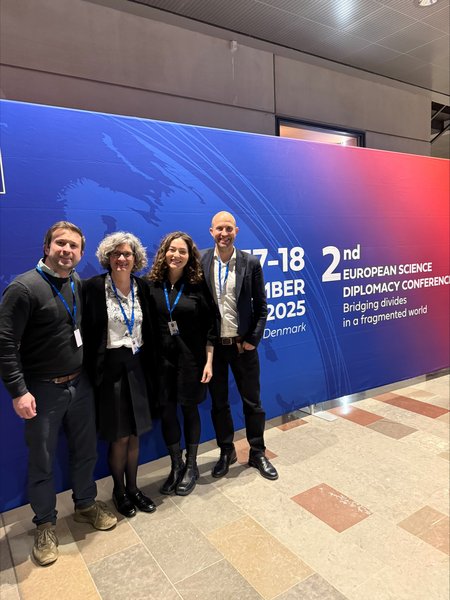
More than 500 participants, researchers, practitioners, industry, NGOs, policymakers, ambassadors, diplomats, from across the world came together for the two-day 2nd European Science Diplomacy Conference: Bridging divides in a fragmented world held in Copenhagen, as part of the Danish EU presidency. In a world marked by poly-crises and geopolitical instability the topic of the conference was more urgent than ever – an urgency that clearly came through in keynotes, panel contributions and discussions.
Securitization and a call for openness
AIAS Science Diplomacy Fellow Casper Andersen joined as panellist in the plenary session ‘Securitization of Science and its Impact on Science Diplomacy’ that focused on how open or closed the world should be in a geopolitical climate of tension. Issues of protection of intellectual property and dual-use, how science can be misused for e.g. military purposes, were discussed as well as the current dilemma we are facing: a strong need for global collaboration to solve the ‘borderless’ poly-crises, such as the climate crisis, which is difficult in a context of geopolitical tensions that hinders and restricts the free flow of research necessary to unite on these global challenges.
Casper Andersen advocated for open research and for the protection of younger researchers to avoid excessive burdening in dealing with restrictions and for building new partnership; also stressed by Matsumoto (Japan) in proposing a ‘trusted openness’ and a bottom-up, researcher-to-researcher, science diplomacy. Sir Mark Walport (UK) emphasized that disruption is here to stay, therefore “let us not drown in a sea of regulations” but rather let universities have responsible collaborations.
Values and ethics – win-win diplomacy
Maria Rentetzi moderated the plenary session on ‘Values and Ethics of Science Diplomacy,’ opening the panel discussion with a call: “We need to redefine our values,” referring to ambassador Macharia Kamao’s powerful keynote that delivered a wake-up call to the EU to take leadership: to react and start engaging with African countries now, before it’s too late, and before others have taken over this relation.
This panel focussed on academic freedom and human rights, how science is a societal good and part of human creativity and something everyone should benefit from (which is not the case currently); on solidarity and our responsibility to respond and defend when autonomy is violated and under threat.
Former Icelandic president Olafur Ragnar Grimsson warned:
“Let us not be imprisoned in the prevailing spirit of the time,” and proposed instead a global, unrestricted platform to unite across borders and sectors to tackle the urgent, borderless climate crisis.
The Publics in Science Diplomacy
Casper Andersen moreover presented at the panel ‘Where are the Publics in Science Diplomacy?’ co-organised by The Royal Danish Academy of Sciences and Letters and the Danish Centre for Studies in Research and Research Policy. This panel discussed the role of the publics in science diplomacy, and the potential consequences if we do not consider, engage and co-create with civil society - potentially leading to mistrust in science, polarisation and a widening gap between the public and researchers.
“Universities should turn from the usual ‘transmitter mode’ to an engaging, inclusive and open ‘receiver mode.’ Bringing in civil society is also a matter of democratic legitimacy,” Casper Andersen encouraged.
Universities on the Frontlines of Science Diplomacy
In the SciDip talks session, researchers of Science Diplomacy presented new research in the field of Science Diplomacy and Science Diplomacy networks to connect with. In her presentation ‘Universities on the Frontlines of Science Diplomacy’ AIAS Science Diplomacy Fellow Rachel Fishberg shared her ongoing study of Danish universities and how they adapt to security policy. Fishberg observed that Danish universities are not only aligning with security policy rules but act, on a daily basis, as active agents in institutionalising risk management etc. She concluded by urging that there are currently many opportunities to understand and more intentionally shape the role that universities can proactively play in cultivating science diplomacy approaches.
Initiatives presented in the session offered a Science Diplomacy COST network to connect with more than 200 researchers, and AIAS acts as a research platform for this emerging field of science diplomacy with a current Science Diplomacy group and an upcoming conference ‘Imagining New Ground for Science Diplomacy’ on 16-17 June 2026 that aims at themed journal publication output, contributing with novel reflections and perspectives on the field of science diplomacy.
See the programme and the speakers of the conference here:
https://eu-science-diplomacy.service-facility.eu/
Contact
Casper Andersen, AIAS Science Diplomacy Fellow & Department of Philosophy and History of Ideas, Aarhus University, Denmark
E-mail: ideca@cas.au.dk
Aarhus Institute of Advanced Studies, AIAS
Høegh-Guldbergs Gade 6B
DK-8000 Aarhus C
Danmark