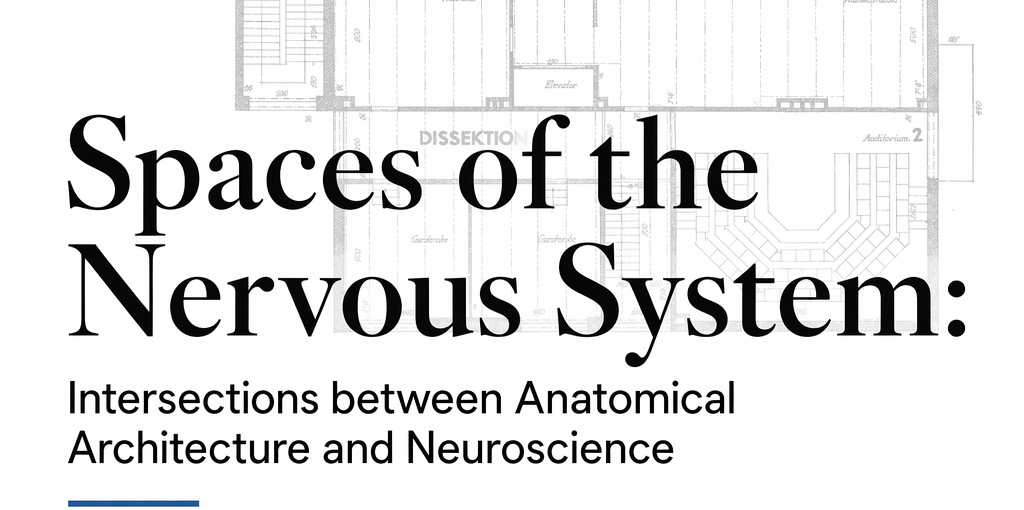
The twentieth century witnessed a profound transformation in medical knowledge production, marked by a shift from anatomy's sensory engagement with the human body toward laboratory-based and technologically mediated approaches associated with neuroscience. While historians of medicine have examined this epistemic transition, significantly less attention has been paid to the architectural environments that both enabled and reflected these changing scientific priorities.
This workshop takes the first Anatomy Institute at Aarhus University, built in 1933, as a focal case for investigating the relationship between
space, pedagogy, and disciplinary identity.
The case offers a rare opportunity to examine how architectural ambition, institutional priorities, and emerging scientific paradigms intersected at a formative moment in modern medicine. More broadly, it allows us to ask how buildings function not merely as containers of knowledge but as active participants in shaping scholarly
practice. Bringing this case into dialogue with international perspectives enables a comparative discussion of how anatomical spaces across Europe and North America were adapted, repurposed, or rendered obsolete during the twentieth century.
| Day 1 - Monday, 15 June 2026 | |
| 9:30 | Short participant introductory presentations |
| 10:30 | Refreshments |
| 11:00 | Donna Briggs Bødtkjer: Presentation on the history of Aarhus University's first anatomy institute, followed by a guided walking tour of the campus to view the building |
| 12:30 | Lunch |
| 13:30 | Christine Beese: Presentation on the history of the anatomical theatre and introduction to five discussion terms |
| 14:30 | Group discussion focused on the terms presented, followed by independent reflection time or smaller breakout group discussions |
| Evening | Synthesis and writing in preparation for Tuesday |
| Day 2 - Tuesday, 16 June 2026 | |
| 09:00 | Group reflections |
| 10:30 | Refreshments |
| 11:00 | Group discussion on publication output and/or a future network development meeting |
| 12:30 | Lunch |
| 13:00 | Wrap-up and evaluation of the workshop |
| 14:00 | Workshop ends |
Donna Briggs Bødtkjer: db@biomed.au.dk, Christine Beese: Christine.Beese@rub.de
The workshop is supported by the Carlsberg Foundation, grant CF26-0304.