
From the Arctic to the Antarctic – climate and storytelling in harsh conditions
In the third Science & The Flavour of Aarhus talk, polar researcher and award-winning photographer Jeff Kerby from Scott Polar Research Institute at the University of Cambridge shared photos, drone footage and geospatial visualizations to take participants on a stunning virtual research journey: from searching for the northernmost flower in the world at the top of Greenland to high-lighting the potential for archaeological research in Antarctica.

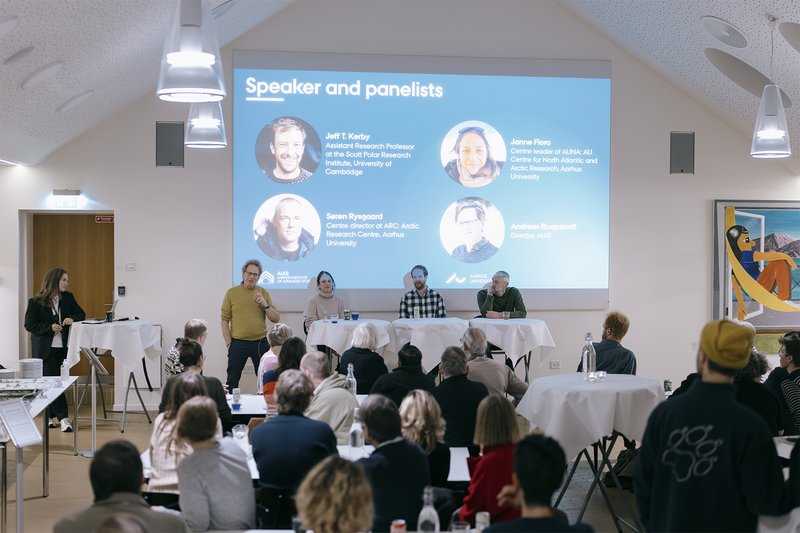
Polar research, images and storytelling was in focus in this week’s Science & The Flavour of Aarhus talk 'From Greenland to Antarctica: shifting contrasts in a time of change' with ecologist Jeff Kerby, a 2020-2023 AIAS Fellow, now at the Scott Polar Research Institute at the University of Cambridge. In his talk, Kerby presented scientific results through photo narratives from his recent fieldwork and expeditions to Greenland and Antarctica.
Benefitting from scale – combining images and field trip observations
Jeff Kerby is an expert in scale – he combines broad-scale data from satellite, GIS and drone mapping with fine-scale details from field observations of landscapes, animals and plants. This combination of methods offers a nuanced and detailed picture of how ecological environments in e.g. Greenland are responding to rapid climate change but also reveal insights into how this affects humans in these regions, both in the past and present.
The ’greening’ and the ‘browning’ of Greenland
Concretely Jeff Kerby studies what ecologists refers to as the ‘greening’ and the ‘browning’ of Greenland – the tundra regions that are undergoing rapid changes due to climate change as shrubbier vegetation expands and permafrost soils thaw. The carbon-storage in the ground in the Arctic is vast – when the permafrost areas thaw, some of this ancient carbon can re-enter the atmosphere. Plants are at the interface of slowing down or speeding up these processes.
An intertwined story – herbivores and humans
Kerby is also specialising in large herbivores, musk ox and caribou, and study their interplay with and capability to help transform the ecology of the landscapes, with potential benefits for the environment and the humans living in these areas. As Kerby pointed out:
The global human story is very much linked to large animals.
Kerby discussed how the pursuit of mammals for hunting has been a pathway for human exploration and movements in both polar regions. A potential win-win scenario in the Arctic is when large herbivore populations increase, benefiting northern communities with more opportunities for hunting and tourism, while also reducing shrub growth that promotes permafrost thaw. Working with local communities is critical when planning, conducting and sharing research.
Interdisciplinary discussion – learning from the poles
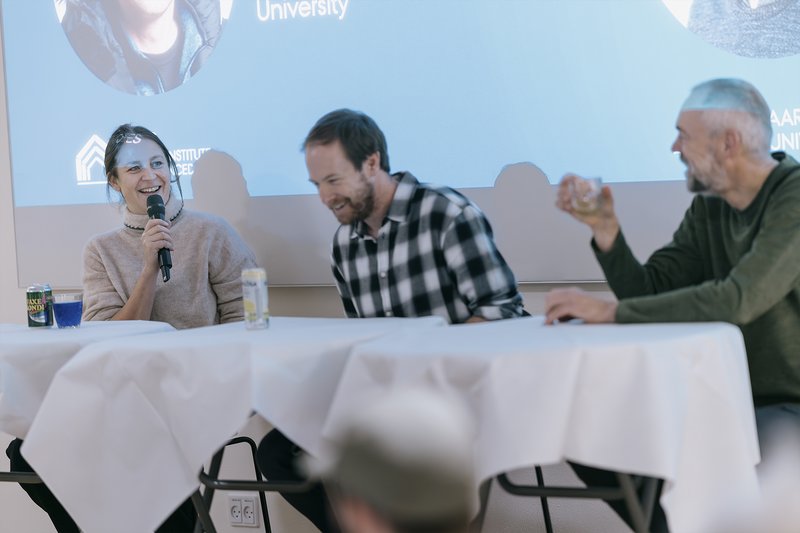
Jeff Kerby’s talk was followed by discussion with the interdisciplinary audience and a panel with anthropologist and director of the new centre AU Centre for North Atlantic and Arctic Research (AUNA) Janne Flora and centre director at Arctic Research Centre (ARC) Søren Rysgaard, moderated by AIAS director Andreas Roepstorff.
Some of the key points from the discussion were:
- It is crucial to work closely together with the local people and institutions in Greenland to find overlapping circles of interest. Such collaboration enables co-creating ideas and research proposals with local communities and institutions, and learning from local knowledge and insights so the research conducted is a joint effort and will benefit the most and disturb the least in the local natural environments.
- We can learn a great deal from the Greenlandic holistic worldview – seeing the world as one in opposition to a segregated view of environment, humans and animals.
- Building and supporting local institutions in Greenland to offer places for collaboration, education and development on a local scale is important. Other Arctic areas can learn from this.
- Images (satellite, drone footage, timelapse camera, photos etc.) are clues to processes that govern ecological function and social-ecological relationships. Images are a great source – for narratives, scientific and geospatial baseline and data archive, and can help address old, unanswered questions and inspire to thinking in completely new domains.
- The current geopolitical situation and tensions call for even more emphasis on strong and trust-based collaborations to solve some of the bigger issues such as climate change or address more local immediate concerns such as small village isolations from Nuuk or the (complex) relation to Denmark.
“Polar expeditions are beyond scientific passion with the tough field trip conditions of for instance an Antarctica expedition. What motivates you?”, asked Science Diplomacy fellow at AIAS Maria Rentetzi during the discussion.
Jeff Kerby finds research expeditions a great opportunity and source for inspiration and sharing stories and results from these remote areas are a way to inspire and motivate other people to explore and collect data and images to contribute with knowledge to better understand our world. But foremost, that are ways to connect ideas with reality and to promote better science and collaboration.
More about the ‘Science & the Flavour of Aarhus’ talk with Jeffrey Kerby
The third Science & the Flavour of Aarhus talk was organized by Aarhus Institute of Advanced Studies (AIAS) in collaboration with the Arctic Research Centre (ARC) at Aarhus University and Scott Polar Research Institute (SPRI) at University of Cambridge, UK.
https://aias.au.dk/events/science-and-the-flavour-of-aarhus-jeffrey-t-kerby
About Jeffrey Kerby
Jeff Kerby is Assistant Research Professor at the Scott Polar Research Institute at the University of Cambridge, and a former fellow at AIAS and the Arctic Research Centre at Aarhus University. He studies ecological dynamics in polar regions, with a focus on vegetation change and ecosystem processes, and how they are shaped by large mammals and human influences.
He is also an accomplished science and expedition photographer whose work has featured in National Geographic magazine, BBC Natural History Unit productions, and in multiple films. His National Geographic Gelada Monkeys Feature, a photo essay on gelada monkeys in the Ethiopian highlands where Jeff lived and conducted research across several years, was the Grand Prize winner of the Banff Mountain Film - Mountain Photo Essay contest.
Jeff Kerby's work has also been awarded category prizes and honorable mentions such as at Por el Planeta, Mexico City, and various science photography events. In 2023, he co-produced an award winning extended reality (XR) experiences exploring climate change impacts on Qikiqtaruk-Herschel Island in Arctic Canada, with support from collaboration grants from the National Geographic Society and Meridian Treehouse. More information about this work at ArcticXR.com. In 2025, he was recognized by The Explorers Club among the 50 extraordinary people who are doing remarkable work to promote science and exploration.
Contact
Andreas Roepstorff, AIAS director
E-mail: andreas.roepstorff@aias.au.dk
Aarhus Institute of Advanced Studies, AIAS
Høegh-Guldbergs Gade 6B
DK-8000 Aarhus C
Denmark