
Bringing the creative arts, research and innovation together for societal transformation
The screening of the documentary film SOLUTIONS directed by Pernille Rose Grønkjær sparked passionate conversations at AIAS, leaving transformative traces. The film doc-uments a dark time marked by polycrises, and yet, it injects hope as it identifies actual solutions. Though, discussions at AIAS pointed to a critical, factor: researchers may lack agency, and do not have the authority to act crises and implement solutions.

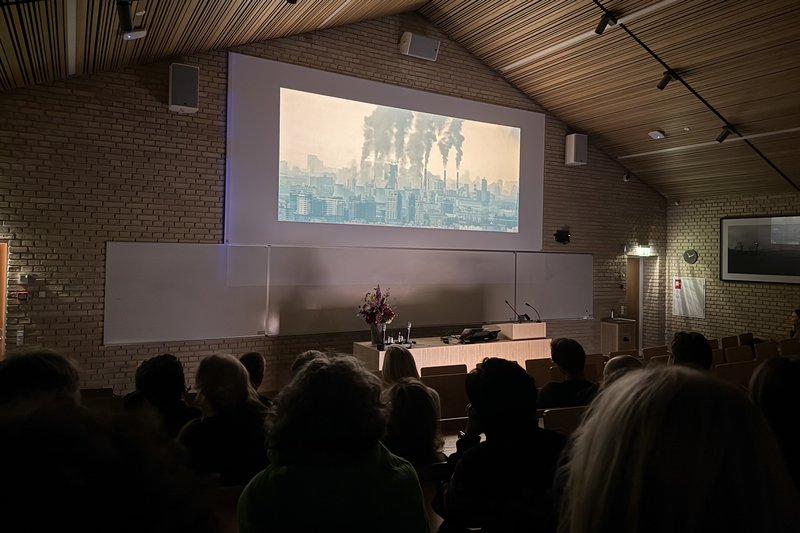
AIAS and the Kitchen, Aarhus University’s hub for innovation, brought together researchers from all faculties, journalists, innovators and people from industry to watch the documentary SOLUTIONS. The film follows 20 researchers, policymakers and NGO’s as they spend 10 days at the Santa Fe institute to identify global challenges and come up with solutions.
The creative arts to drive and transform our interdisciplinary mindsets and innovation
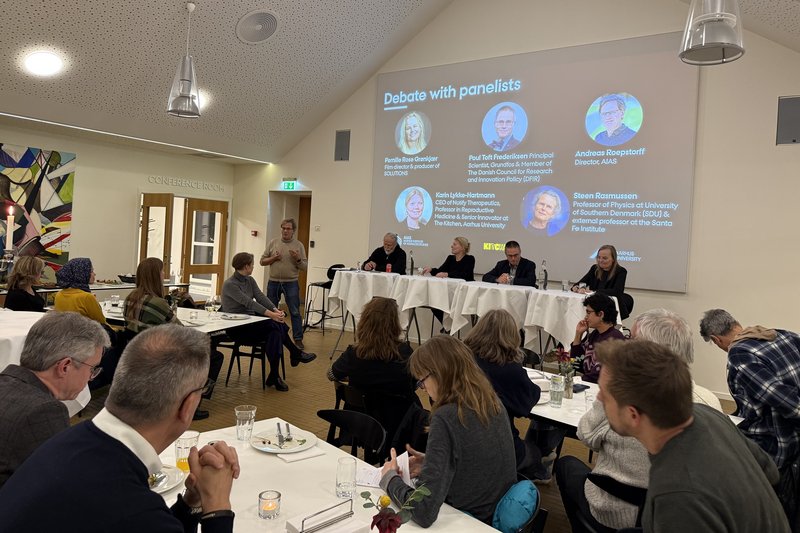
Following the screening of SOLUTIONS was a panel debate including film director Pernille Rose Grønkjær; professor of physics Steen Rasmussen, who took part in the Santa Fe Summit and the documentary; principal scientist at Grundfos and Danish Research Council member Poul Toft Frederiksen; and professor in reproductive medicine Karin Lykke-Hartmann, CEO & Founder of Notify Therapeutics, and Distinguished Senior Innovator at The Kitchen, moderated by AIAS Director Andreas Roepstorff.
From the discussion and many critical reflections from participants two things stood out clearly: that the film successfully functions as a tool to spark conversations across disciplines and sectors and move people’s mindset; and that a genuine interest in interdisciplinary and cross-sector collaboration is present.
Complex problems, complex knowledge and complex teams
Some of the ideas that came out of the debate and film were:
- We need artists and people from creative industries who can facilitate conversations across disciplines and sectors and help formulate visions and positive narratives for the future that in turn, can drive innovation
- Solutions to complex problems should be thought of in a broadest sense – they are not just technical fixes but also about communication, coordination and meaning-making. They thus critically engage also social and cultural fields and sectors
- The current funding bodies, initiatives and systems are not geared towards accessing and rewarding interdisciplinary projects and collaboration. This lead to a strong call to accommodate interdisciplinary projects institutionally not just by allocating more funds, but also rethinking incentives, career trajectories and risk-taking at universities
- When forming interdisciplinary groups, such as the Sante Fe Summit, we need Global representation, to have a diverse and plural knowledge production for addressing global challenges
- In addition to solutions, one may potentially look to the Nordic Countries for exemplars of practices for innovation as they thrive in environments characterized by collaboration, equality and trust
- A dilemma was stressed – we may have solutions, but there is a lack of agency: researchers do not to have the authority to act and implement solutions.
By way of conclusion Poul Toft Frederiksen (Grundfos) encouraged: “If we are enough, we do have agency”. That call closed the evening and opened a path for follow-up. How to foster interdisciplinary collaborations within academia and with societal stakeholders to find and implement solutions? AIAS hopes to open a space for continuing that exploration.
About the SOLUTIONS debate at AIAS
Contact
Andreas Roepstorff, Director
E-mail: andreas.roepstorff@aias.au.dk
Aarhus Institute of Advanced Studies, AIAS
Høegh-Guldbergs Gade 6B
DK-8000 Aarhus C
Danmark