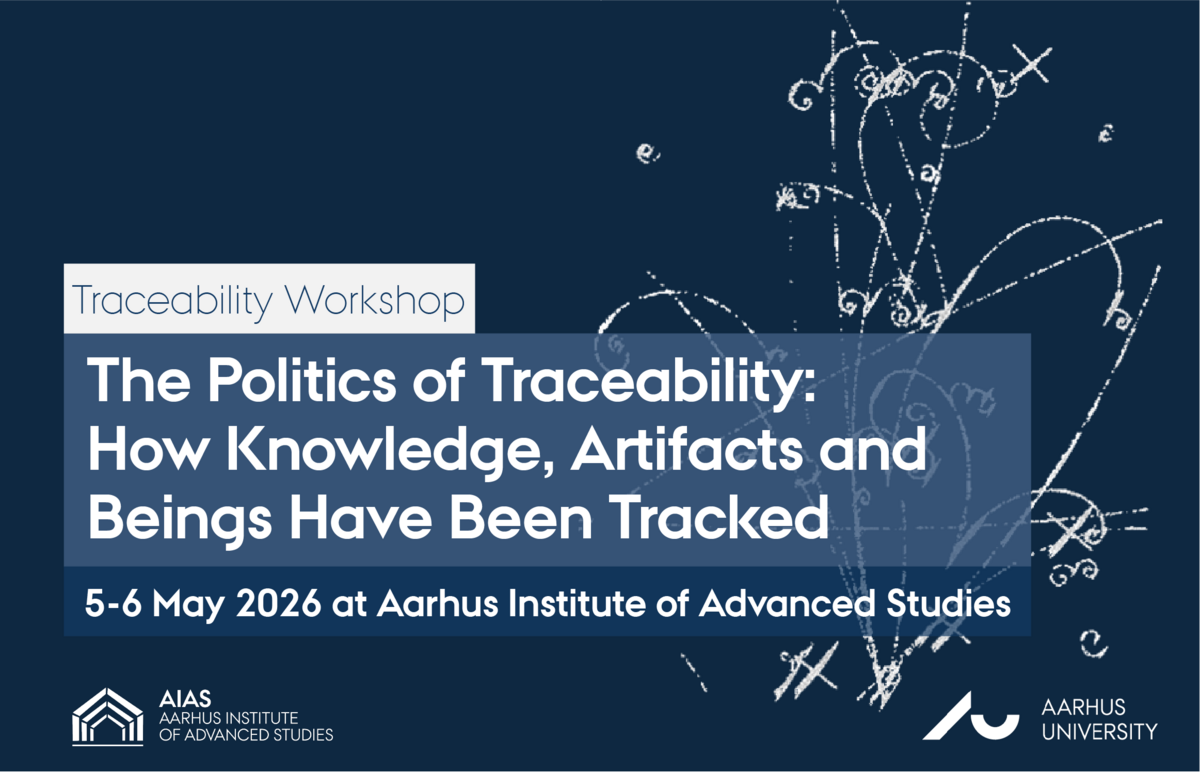
The Politics of Traceability: How Knowledge, Artifacts, and Beings Have Been Tracked
Venue: Aarhus Institute for Advanced Studies, Aarhus University, Denmark
Dates: 5 - 6 May 2026
To trace is to record, store and connect data about movement, transformation, and relations. It is to develop technologies for following people, animals, artifacts, or even knowledge as they flow in a highly fragmented, diverse, and politicized world. It is an equally technoscientific and political act as the practice of tracing raises questions about what is worthy of being traced, how it is tracked, and who is allowed to track. After all, to trace is to literally bind knowledge to power within a system that renders the track legible, recallable at any moment, and at times even immutable. Traceability begins long before barcodes and blockchains. It is written into the Greek treatises of planetary movements, the imperial ledger, the colonial map, the slave registry, and the missionary archive—devices that transformed life into legible data, assigning value and hierarchy. From ancient and early modern cartography to today’s biometric systems, traceability has been central to the ways we learned to see and—some even own—the world.
Considering the historical and current meanings of traceability, this workshop asks what it means to inhabit an era when the trace—whether biometric, archival, atmospheric, or algorithmic—has become the dominant mode of epistemic and political organization.
The workshop is not merely about what can be traced, but also about what resists tracing—the unarchivable, the ephemeral, the withdrawn. Our aim is to convene a conversation—across disciplines, temporalities, and practices—on what traceability is and does.
An interdisciplinary exercise
This is also an interdisciplinary exercise as the organizers come from diverse fields and seek to engage equally interdisciplinary groups of participants. Anthropologist Pierre Louis du Plessis looks into the ways traceability protocols for beef export to Europe shape the spatial ecologies of African landscapes. Cultural biologist Malene Friis Hansen considers the value, vulnerability and neocolonial reality of the macaque trade and questions the very institution set in place to trace and the neoliberal lobbying powers behind it. A physicist long ago now historian of science and STS scholar Maria Rentetzi works on how the technologies used to track diamonds challenge prevailing notions of ethical science, question the practices of science diplomacy in a postcolonial world, and reveal the entanglements between geopolitical power and traceability systems.
Programme for the two day workshop can be found here.
Registration is now open. Please register here.
The workshop is open to all, researchers, practitioners, officials and others, interested in the topics listed above. Participation in the workshop is free of charge, but participants will need to cover their own travel and accommodation expenses.
Please find a document with list of hotels here (the list starts with the pricier hotels) and guidance on how to get to Aarhus here.
The workshop is organized by AIAS Fellows at the Aarhus Institute of Advanced Studies, Aarhus University: