
Questioning Assumptions on Vulnerability in research
A one-day exploratory workshop at AIAS brought scholars from diverse research disciplines together to critically discuss ‘vulnerability’ from interdisciplinary perspectives. It became clear that ‘vulnerability’ is multi-facetted and operates on multiple levels and spheres. What and who is vulnerable is negotiated, relational, context-based and temporal - acknowledging this complexity is crucial.


In her research project at AIAS 'Improving Neurodiverse Cooperation in Academic Research: A Study on (Shared) Time Experience,' AIAS-AUFF Fellow Federica Cavaletti is preoccupied with neurodiversity in research teams, and how neurodiverse researchers are often labelled ‘vulnerable’.
A one-day exploratory workshop on ‘Vulnerability(?) in Research’ is closing Federica’s fellowship at AIAS this week. But the interdisciplinary dialogue on ‘vulnerability’ at the workshop opens new research doors.
Upon Federica Cavaletti’s initiative, with the aid of a varied group of co-organisers and supported by AIAS and the Health Transition at Aarhus University, the workshop set forth to explore and question current assumptions on vulnerability in research.
Seeping through the entire workshop from its formats, to the topics of the talks and the hands-on sessions was a wish to bring vulnerability at play in many dimensions, creating a considerate workshop with room for vulnerability, both as a research object and a human condition.
Proximity and vulnerability
In the opening talk “Closeness and distance in participatory research. Notes from a project in neurodiversity studies," Federica Cavaletti (AIAS, Aarhus University & Università Telematica San Raffaele Roma, Italy) presented results from her participatory study of neurodiverse researchers where she as a researcher moved from ‘being an outsider to becoming an insider’ in using ‘Friendship’ as a method. A method that allowed her to gain insights that a more detached method never would have but also placing the researcher with vulnerable considerations – how close can you go?
Ethical implications of vulnerability
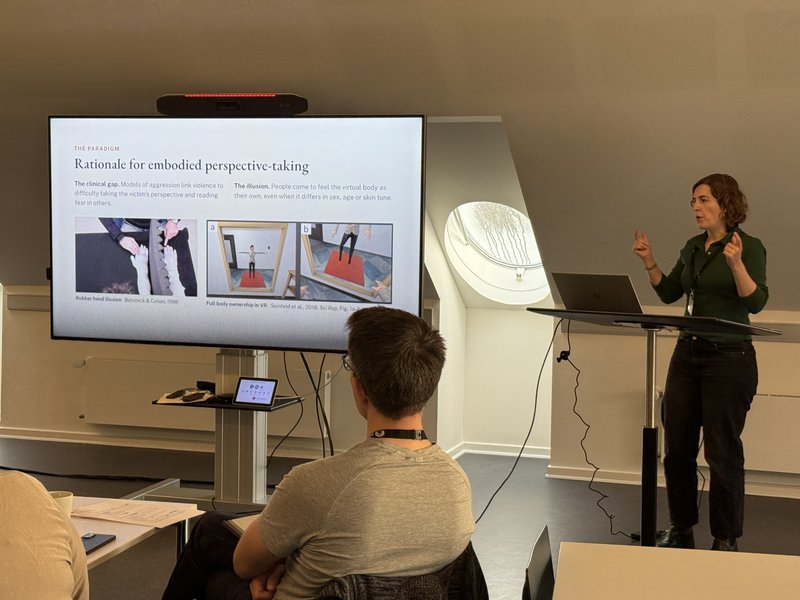
From the Department of Psychology and Educational Sciences at Universitat Oberta de Catalunya, Sofía Seinfeld presented several projects using embodied VR (Virtual Reality) technology to support treatment and re-education of domestic violence offenders in her talk “On vulnerability: Reflections from embodying domestic violence in VR.” Sofía identified and analysed the many vulnerabilities implied in her research, considering the victims’ perspective but also the complex history of some offenders, as well the impact of public scrutiny on researchers addressing sensitive societal issues.
Uncertainty and vulnerability – a human condition?
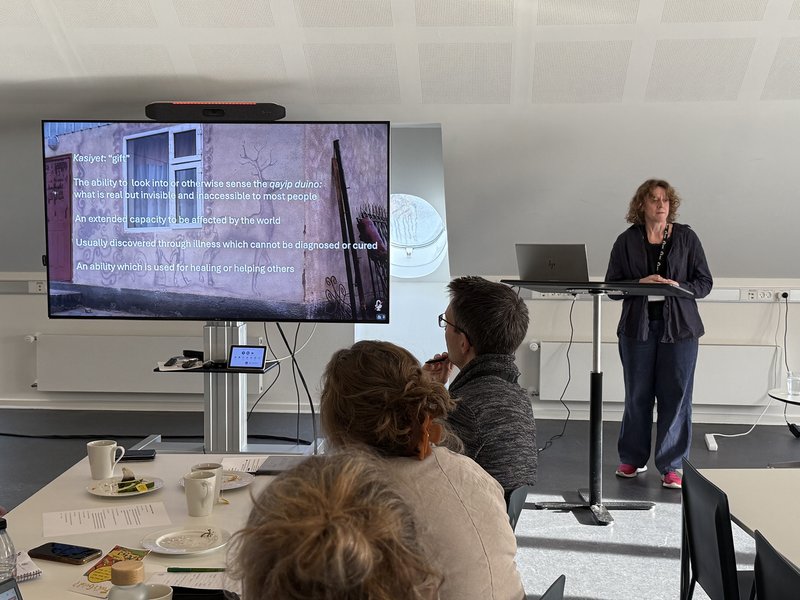
Turning to another part of the world, Maria Louw from the Department of Anthropology at Aarhus University shared narratives from her studies of gifted people in Kyrgyzstan in her talk “Being porous. Spiritual giftedness in Kyrgyzstan and what it may teach us about vulnerability”. Is vulnerability a human condition – a capacity to act upon the world? Louw asked. A talk that also led to discussions on how to act as a researcher when certainties are stripped away when presented with incomprehensible other worlds.
Multiple interactions of vulnerabilities
The topic of ‘incomprehensible worlds’ of Louw’s talk tied well with the last workshop talk “Vulnerable to whom? Risk, care and the challenge of forensic psychiatry” by Morten Deleuran Terkildsen from the Department of Forensic Psychiatry at Aarhus University. Terkildsen discussed what happens when different types of ‘vulnerabilty’ interact and meet when patients are admitted to Forensic Psychiatry and researchers are presented with multiple kinds of realities. How do professionals take concrete measures to protect all those involved? And how do we account for this in research?
Key points that were discussed were how vulnerability works at several layers where at the same time researcher, research participants or objects, the context/ society and the research results are vulnerable, and when, how and who is vulnerable is negotiated, relational, context-dependent, temporal and (un)equally distributed.
The discussion took on a more “hands-on” orientation in the activities proposed in the afternoon, where workshop participants worked in pairs or small groups to reflect on vulnerability in their current research and how to address vulnerability in projects to come.
More about the workshop
https://aias.au.dk/events/vulnerability-in-research
Contact
Federica Cavaletti, AIAS-AUFF Fellow
E-mail: federica.cavaletti@aias.au.dk
Aarhus Institute of Advanced Studies, AIAS
Aarhus University,
Denmark
From 21 November 2026:
E-mail: federica.cavaletti@uniroma5.it
Università Telematica San Raffaele Roma,
Italy