
A call for discretion and subversion for the improvement of society and our well-being
In the fourth Science & The Flavour of Aarhus talk co-organised with Magtudredningen 2.0 and Afmagt.dk, renown sociologist Hartmut Rosa, director of the Max-Weber-Kolleg in Erfurt, gave a clear critique of our modern, accelerated society and its disempowerment of the individual that leads to the rise of burnout. Rosa’s new social theory ‘Situation and Constellation’ and ‘social en-ergy’ offers new perspectives and insights.

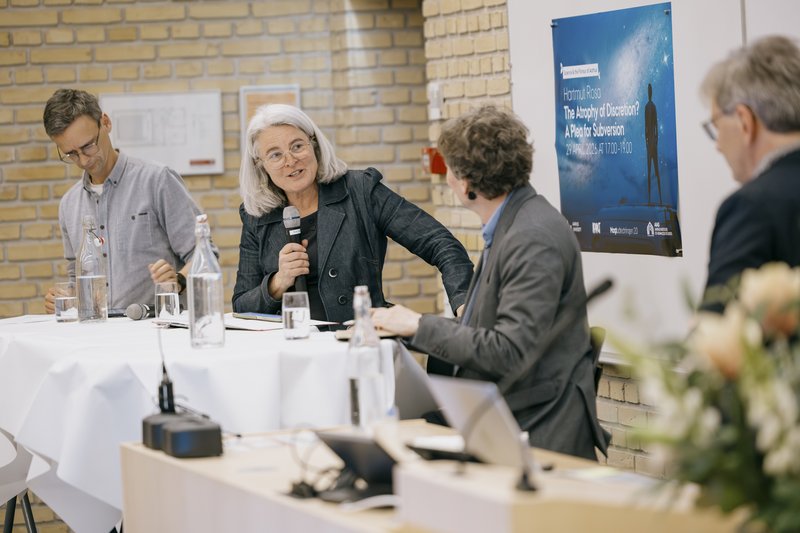
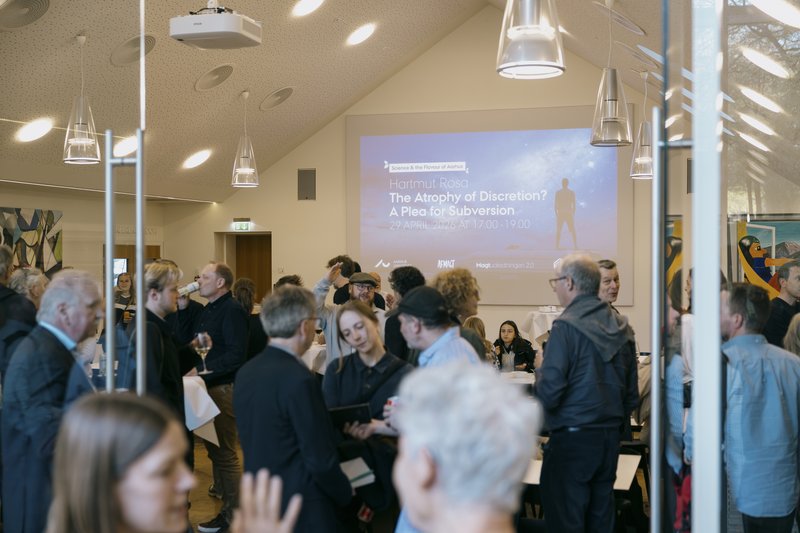
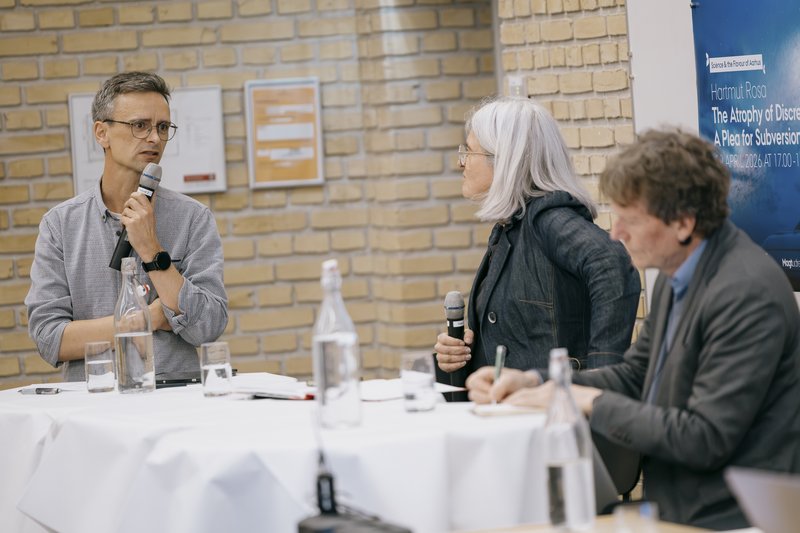
In an informal and engaging presentation style built on anecdotal examples from ordinary life, of football, the Hyberburger, cooking and teaching, sociologist Hartmut Rosa presented his new social theory on ‘Situation and Constellation.’ This theory is a call for reintroducing agency, discretion and emotion into the lives of individuals and in society to counterbalance our contemporary all-pervasive implementation and constellation modes that are based on algorithms, automisation and the measurable. For Rosa life is made up of complex situations, and the problem is that what is complex is now reduced to simple constellations.
Judgement and emotions replaced by implementation and constellations
In our constant search for optimization in an accelerated society, we have replaced judgement (or ‘discretion’) with rules and systems. We are hereby severed from what nourishes us as human beings: our ‘emotions’ that provide the energy for our actions. In football, the referee is disempowered as the VAR is introduced and can overrule and replace the judgement of the referee. In home care, situational needs of the elderly are replaced by lists and rules disempowering the caretaker.
“If you take away agency and judgement, people feel horrible, and we end up with bullshit jobs,” Rosa diagnoses. We can explain the rise of burnout and political rage exactly because agency and the ability to judge based on experience are taken away from us. We have become ‘disempowered’ and instead replaced by ‘constellations’ that are measurable, quantifiable, documentable, controllable etc.
Why do we go from situations to constellations and this disempowerment, Rosa asks? The logic is to avoid corruption, bias and to ensure justice, accountability and the right to equal treatment. When you are forced to permanently optimize, you must retort to simple constellations, and you must ignore and overrule your emotions and judgements. To counter this, Rosa has a plea: to keep our sensibility and situational judgment and allow for a certain rule breaking as life is always more complex than the constellations allow for.
A concern was raised in the audience that Rosa is taking his argument too far: “A decent society cannot work without a set of rules, and who should decide what is legitimate or not – we can easily end up in corruption?” Hartmut Rosa acknowledges that we need rules and constellations and they may also improve agency, but the problem occurs when we replace agency with ‘a constellation logic.’
Powerlessness - The HyperBurger anecdote and Danish digitized society
Panelist Lene Holm Pedersen from Magtudredningen 2.0 and Professor at University of Copenhagen compares Hartmut Rosa’s HyperBurger anecdote with public administration in Denmark:
“Situation and constellation change. Rosa's example with the poor girl who drops a burger (the HyperBurger), and the salesman who cannot offer her a new one because there must be payment on the payment panel before production can start. This exists in countless forms such as in a digitalized public administration like the Danish one – and it creates powerlessness (afmagt). It is spot on. But in a democratic society, you have the opportunity to make decisions about how the system should be set up. Do you see any possibilities for a well-functioning democracy to stem the 'atrophy of discretion'?”
Hartmut Rosa has hopes for a better world by creating a society with situational responsibility in which there is a certain ‘Spiel Raum’, room given to people to act based on judgement.
Lene Holm Pedersen responds: “In Denmark, we have more and more documentation requirements to fulfil the demands for equality in the welfare provision. However, there is a paradox that needs to be resolved. In order to treat our kids equally we often have to treat them differently. In public administration it is acknowledged by the administrative rule stating that an authority must not fetter its discretion. Authorities may adopt general guidelines or established practices, but they must always be willing to depart from such practice where the specific circumstances of the case so warrant. However, this rule is under pressure from digitalization and documentation requirements”.
According to Rosa, we need to accept certain forms of inequality, otherwise we have to make up more and more rules.
The butterfly and the cocoon – friction and well-being?
Panelist Henrik Reintoft from the Study of Religion at Aarhus University and member of the Afmagt.dk-project starts with a butterfly and cocoon anecdote to continue in the presentation style of Hartmut Rosa. The butterfly gets power and strength from fighting to break out of the cocoon; if it gets too much help, it will wane away and die. “This ‘friction’ that happens here – which role does it play in your theory?” Reintoft asks. To Rosa ‘friction’ is what helps you get agency and develop judgement based on experience, and sometimes pain. If we remove friction, well-being will go down.
“What happens when the motor goes down, if people attempt to optimize through discretion and personal judgment?” Reintoft replies. As soon as you introduce a set of rules and seek to control life, it will not work, Rosa concludes.
Next week, Hartmut Rosa’s most recent book on ‘Situation und Konstellation’ is published in Danish under the title ‘Situation og Konstellation. Om Tabet Af Spillerum’ på forlaget Eksistensen.
More about the ‘Science & the Flavour of Aarhus’ talk with Hartmut Rosa
The fourth Science & the Flavour of Aarhus talk was organized by Aarhus Institute of Advanced Studies (AIAS) in collaboration with the project Magtudredningen 2.0, the Danish Power Inquiry initiated by the Danish Parliament, and the research project Afmagt.dk, supported by the Velux Foundation.
https://aias.au.dk/events/science-and-the-flavour-of-aarhus-hartmut-rosa
About Hartmut Rosa
Hartmut Rosa is Professor of Sociology and Social Theory at Friedrich-Schiller-University in Jena, Germany, and Director of the Max-Weber-Kolleg at the University of Erfurt. He has been an Affiliated Professor at the Department of Sociology, New School for Social Research, New York, 2001-2006. In 1997, he received his PhD in Political Science from Humboldt-University in Berlin. After that, he held teaching positions at the universities of Mannheim, Jena, Augsburg and Essen. His publications focus on Social Acceleration, Resonance and the Temporal Structures of Modernity and have been translated in more than 25 languages. In 2023, Hartmut Rosa was conferred an Honorary Doctorate at Aarhus University and appointed an AIAS Honorary Doctorate Fellow. In the spring of 2026, Hartmut Rosa is a Visiting Fellow at AIAS.
Contact
Andreas Roepstorff, AIAS director
E-mail: andreas.roepstorff@aias.au.dk
Aarhus Institute of Advanced Studies, AIAS
Høegh-Guldbergs Gade 6B
DK-8000 Aarhus C
Denmark